Saturday, 14 October 2017

Blade Runner 2049 review, More Blade Runner than Blade Runner

It’s easy to forget that Blade Runner, the classic millions of now know and love, was not well received back in 1982. With too much studio interference leading to a product Ridley Scott was not happy with. It wasn’t until 2007 that Blade Runner: The Final Cut was released which then gave audiences the best version of the film, as well as the one Scott deemed worthy of his original image for the movie. Another 10 years later, Denis Villeneuve has directed a film that is worthy of the Blade Runner name, but as a film that expands its universe in ways we, as an audience, never knew were possible. Blade Runner 2049 is a visually breath-taking spectacle that asks different question. It asks, “What does it means to be more than human?”

Blade Runner 2049 takes place 30 years after the events of the original and introduces us a new Blade Runner named K. His job is to locate illegal Replicants residing on Earth and ‘retire’ them. This has been made subsequently harder after the Blackout, an act of sabotage destroying the Replicant database so that they may live without being tracked. After dealing with one Replicant known as Sapper Morton, he proceeds to tells K why he can do what he does saying, “It’s because you’ve never seen a miracle.” This then drives the film and K’s motives as he begins to uncover a string of mysteries which take him to the doorstep of Rick Deckard, so that he might shed light on his strange case. To add extra gravity to the situation, the Wallace Corporation are also in pursuit of this information. Having saved the world and its colonies from the brink of crisis, Niander Wallace took over what was left of the Tyrell Corp. and used it to create a new line of Replicants, more resilient and more obedient than ever. That is as much as I’ll say about the plot because I must not give anything away. Spoiling things about this movie does it a complete disservice.

Do we know each other?

It should probably go without saying that I am a big fan of Blade Runner, and even more so with its excellent sequel. Denis Villeneuve, most known for Arrival and Sicaro, has done what seems like an impossible task: take a beloved movie from the 1980s, create a sequel which follows the story well and make it not only just as good, but even better. Having worked closely with Ridley Scott and Hampton Fancher, director and screenplay artist, who created the world of the original, 2049 gives us an expanded view of not just the dystopic Los Angeles, but the radiated wastelands of California and the garbage dumps of San Diego show how broken this world has now become. The gigantic neon advertisements, the construction and form of Joi (K’s virtual girlfriend) with a vast colour palette that matches the dynamic its surroundings, this is a film that generates a sense of pleasure by letting you absorb the ironic beauty of a dying world. Whatever the weather, this film works best on the cinema screen as you need something of that size to captivate you in every way. What submerges you in the world is the soundtrack. Hans Zimmer and Benjamin Wallfisch have created something that sounds equally as technical and futuristic as the original, but something that is also menacing and unsettling. This allows us to feel awe-inspired at the majesty of what we are witnessing, and fearful of how the soundtrack illustrates the underlying darkness that operates in this world. Meeting Wallace for the first time is intimidating not only because of the way Jared Leto plays him or because of his Egyptian-like surroundings, it is the power of the soundtrack that binds these factors together to create something far more sinister.
"Look on my Works, ye Mighty, and despair!

The other part of what makes Blade Runner 2049 works is its pace. Yes, this is a long film clocking in at almost 3 hours but it’s a story that needs time to be told. There is no way you could condense this story into a shorter film. There are even 3 short film that explore the happenings in the 30-year gap between the films, but are best experienced after the watching 2049 so you can then come to better terms with the lore yourself. The plot needs time to tell you each detail, much like how a detective goes about solving a case. Each new piece of evidence proposes new questions, and those questions propose more questions and it is only after that we are given a few resolutions to how certain things are and why they have come to be. In other words, this is a film that  requires your attention.It assumes you are smart enough to connect the dots between the clues that ask why K is so invested in solving this case that continues to blur the combined definitions of what separates humans from Replicants.

"All those moments will be lost..."
This then re-introduces us into the philosophical questions the first film asked, what it means to be human and then in relation to that question, how ‘human’ are Replicants? This film questions the nature of the soul, with K being told early in the film that he’s been doing just fine without one. What does that mean? Does having a soul mean you are able to follow a set of morals and not just a set of orders? Luv, Wallace’s Replicant assistant, obeys him in every action, but again shows signs of independence which blurs the definition of what it means to be human, as how do you engineer free will? Well, as we see in the original, Rachel choses to run away with Deckard after he tells her she is a Replicant. Batty and his band of misfits come to Earth to escape their enslaved lives on the colonies and in turn, look for ways to extend their lives further than the 4 years they are given. The same can be said for some of the characters in Blade Runner 2049 but without spoiling it, these new Replicants have their extended life but look for meaning in their life, as any sentient being would. To quote Descartes, “I think, therefore I am.” You may then ask; how do we tell who is Replicant and who isn’t? Well, we can’t and that is the point.  The lines between what is and isn’t human does not apply to how 2049 tells its story of Replicants evolving to becoming more than mere slaves to the human race. Joi is the AI sold to the public as a life like companion. The most interesting part to her character is that she is conscious of her existence as a program not only as code, but as a physical being in her projected form. How can a machine see think and feel? Isn’t that what a human does? The motto of the Tyrell Corp. was “More human than human” and this is precisely what we are given. Go ahead and take the Voight-Kampff test, not as easy as you might think to prove you’re human… http://www.bfi.org.uk/are-you-a-replicant/ 


The performances in this film add that final touch of brilliance to its components. Ryan Gosling gives a great performance as Officer K in the way he is able to adapt his character to the new scenarios he finds himself in and doesn’t let up for the entire film. Harrison Ford also gives a great performance reprising his role as Deckard by showing just how much he has aged and changed in these 30 years. Paralleling these two Blade Runners side-by-side allows for an interesting turn of events as both go through similar experiences regarding their investigations, but become completely different characters because of what they end up discovering, leaving for some nice tension when they first meet. Ana de Armas’ Joi gives the best performance, in my opinion, as her characterisation of the mass-produced relationship AI really begs the question, are her feelings genuine or artificially pre-programmed and artificial? Jared Leto’s presence in the film is very minimal considering he is meant to be this new global superpower, but his will power to dominate is manifested in his unrelenting assistant Luv, played by Sylvia Hoeks. 


Far more likely to shoot first
To summarise, this is a special movie. I found it rather difficult to write this review and not say anything that might spoil the plot, and a person’s attitude to wanting to go and see this film. I feel I have exhausted ways in which I can praise this film without giving anything away and so must end it here. Alternatively, I am more than happy to talk with those who have seen the film. These talks will most likely lead to debates about what Blade Runner 2049 is really trying to tell us, making it such a prefect Blade Runner sequel.


9.8/10

Sunday, 8 October 2017

Kingsman: The Golden Circle review, The Golden Plated Circle is more accurate here

Mathew Vaughn is a great film maker. By bringing us Kickass, Kingsman: The Secret Service, X-Men: First Class and many other films, he has solidified himself as a consistently good writer and director. Imagine my disappointment, then, when I watch Kingsman: The Golden Circle and discover that it suffers from the all too familiar case of what I like to call ‘sequel syndrome’. Trying to recreate the same essence of crazy action and hilarious writing was always going to be difficult in respect to following up The Secret Service as it’s hard to catch lightning in a bottle twice. Where there are remnants of decent action set pieces, great acting with the odd funny lines here and there, they can’t save the film from being a sequel with very few original ideas. 

Does this all feel a little familiar to you?
After saving the world, Eggsy has earned the codename Galahad and is now a fully-fledged member of the Kingsman agency. The film opens with an incredibly fast paced chase scene as Charlie, a disgraced former Kingsman candidate, tries to steal top secret information from Eggsy as well as kill him for revenge after the events of the previous film. As it turns out, Kingsman have been tracking his whereabouts and uncover he has ties to a shady organisation going by the name of “The Golden Circle”. This organisation is the largest drug ring in the world and the woman who controls it, Poppy, is certifiably insane to say the least. After launching multiple missile strikes on the Kingsman, Merlin and Galahad are the only members left in the organisation and must find the “Statesman”, their American counterpart. It is only then that they discover Harry Hart is now not dead, so they must bring him back to the world of action and espionage to save the world from the evil Golden Circle.

The first thing I need to address is the way this film was marketed. I know Mathew Vaughn was not happy with including Colin Firth’s Harry Hart in the trailers. Stating that the whole including of his survival in the trailers was “stupidity”, he goes on to say, “I begged the studio not to reveal it.” I whole heartedly agree with Vaughn and many others on this front as we are given so many trailers these days that spoil massive plot points in the movies. Terminator: Genysis spoiled that John Connor had somehow been turned into a terminator. Batman vs Superman: Dawn of Justice spoiled that Doomsday would be making an appearance meaning that the film wouldn’t actually be about Batman fighting Superman. Another bone I must pick with the marketing is why how they’ve advertised the actors on posters and in trailers. Channing Tatum’s Agent Tequila features heavily in the trailers but has less than, what seems, 5 minutes screen time whereas Pedro Pascal, best known as Oberyn on Game of Thrones and Peña in Narcos, as Agent Whiskey is not given a place on the poster but has many appearances in the trailer. It is clear that the studio could only get Tatum for a set amount of time and probably had to reshoot with Pascal instead.

In saying what I thought about the marketing setting up the film to be a poor depiction to what we thought might transpire, it brings me on perfectly into what I liked about this film. Firstly, it is Pascal’s performance that redeems a lot of what goes wrong in this film. Any scene he is in, he completely owns with great delivery of his lines with some fantastic fight choreography. Secondly, Taron Edgerton is proving to be a very competent actor. The first film solidified his position as a real up and coming star, by performing alongside British acting heavyweight Colin Firth, and in the sequel to that film, he holds his own very well. There are also some great laughs in this film. Contrasting American and British behaviours and colloquialisms always proves to be funny, and this is most present in the comparing of the gadgets each organisation owns. The fight scenes are always entertaining but I’ll illustrate later why I feel they don’t compel me to talk about them a great deal. Finally, and I can’t put this off any longer, but I should say that the Elton John cameo was at times rather funny. Except, and this is where I venture into talking about the negatives of The Golden Circle, it gets very old VERY QUICKLY.

I’ll let you in on a little secret, Elton John was asked to appear in The Secret Service but said that he didn’t want to. Now, after the surprise success of that film, he said yes to appearing in its sequel. For a cameo appearance, as I state above, it is funny at times but the constant reoccurring gag of Elton John doing Elton John things, Elton John telling people to “Fuck the fuck off!”, Elton John looking at the camera whilst air kicking a guy in the face... I could go on but I won’t. It only gets worse with every appearance. This is but one thing I found really dragged the film down. I’ll talk in detail about the other negative aspects of the film, but I’ll briefly say that the pacing of the film was way off. Opening with a high-octane car chase was a poor move and it doesn’t improve from there. It begins to get rather predicable to say the least.

Literal dead man walking
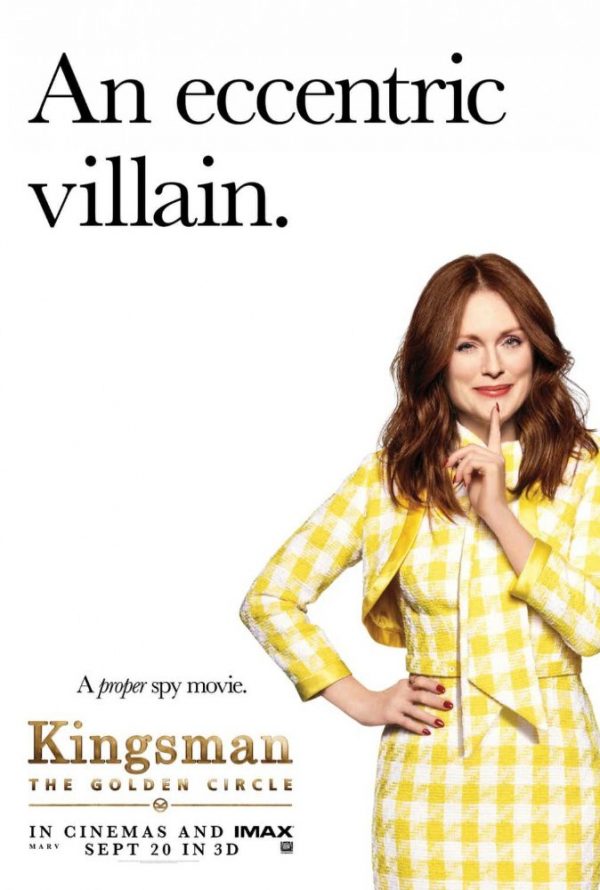
The overriding problem of Kingsman: The Golden Circle is that it lacks new, innovative and creative ideas. Most notably, the survival of Harry. When key characters die and then come back to life, it shatters the thought that our characters are in danger. Much like in video games, the protagonist you might play as in an action game cannot in a sense ‘die’ as you can simply respawn and try again. Kingsman: The Secret Service is a film that forms new ideas of what a spy film is. They reference previous spy movies to show how far the genre has come and to quote Eggsy, “This ain’t that type of movie bruv.” What made the original so good was that it broke new ground on what it meant to be a spy in the 21st century. By miraculously resurrecting a man, who was shot in the head might I add, just because he was so well received in the first film to bring back those fans, is nothing more than a cop out. The bar fight scene is another example of this. The first-time round, it was a breath-taking sequence as you had no idea Colin Firth could move that way and it was just cathartic to watch a bunch of chavs getting smacked about. In this, yes, it’s Whiskey that beats all the rednecks up but the fight is only instigated on the fact that some guy doesn’t like that Harry only has one eye. Why is that enough to warrant him to leave? The first one had purpose as the bunch of guys were looking to beat Eggsy up and forced Galahad to leave, adding a sense of paternal protection to the scene when he fights back. The new one just had no weight behind it. Julianne Moore’s ‘Poppy’ creates another problem. She is given nothing to do and where she clearly portrays madness in her dialogue and actions, there is no sense of dominance or fear when it comes to her dastardly plan. Where, like Richmond Valentine, there is real debate as to whether their actions are justified. Where the culling to save the world from climate change has its sides, the drug trade also makes points regarding these substances being less addictive than alcohol and sugar. Both claims are refuted thanks to the outcomes of these two films but Poppy’s Golden Circle is just not threatening. Valentine had a complete private army, alternatively Poppy has a few personal guards and 2 robotic dogs (yes I just said robotic dogs). 
Nothing eccentric here
I'm afraid

This brings me to the final point I’ll make about the film. Remember how the first movie ended? That scene panning down on Princess Tilde? It was this moment that sparked mass debate about the way the entire movie portrayed women. In the past, I have defended Vaughn’s decision to end this way because it criticises the old ways in which Bond films used to end, with him going off into the sunset to do all sorts of things with the girl he’d just saved. I look back and I must admit that now this was not a criticism, this was a scene that conformed to the sexist tropes of past spy films and completely objectifies the ‘damsel in distress’ character. The Golden Circle takes this idea so much further to the point where I genuinely wanted to throw something at the screen. Eggsy and Whiskey must plant a tracker on Charlie’s girlfriend so they can follow her and gain intel on The Golden Circle’s whereabouts. However, we are shown that this tracker comes in the form of a tiny condom. For it to work the condom must come into contact with a mucus membrane. Eggsy rightly states that sticking it up her nose wouldn’t work so Whiskey points out there are more mucus membranes, and I’ll leave you to decide which one he means. Therefore, the two men decide to fight about which one is going to plant the tracker inside her… I know I previously said that Kingsman is a new type of spy movie so I hear some ask, “Doesn’t this prove that this really is a Kingsman film?” To that answer no. If the Kingsman films were new types of spy movies, they wouldn’t and shouldn’t have to resort to objectifying the female body to carry the plot.

To conclude, I found this film rather mediocre. You may notice that I compare it a lot to the first film rather than a on its own. I have done this because it offers so little to be able to judge it by itself. Having been blown away by The Secret Service I was not looking for a sequel because it concluded with all its stories developed and finished. The Golden Circle left me feeling nothing but disappointment as this did not further anyone’s story arc in a credible manner and did more to hurt this new franchise than improve it. Are we going to get another Kingsman film, of course we are because there is money to be made! Let’s pray that the inevitable sequel is worthy to the original.


5.5/10

Thursday, 5 October 2017

It review, Fear=Clowns+Anything else you’re vaguely afraid of

As someone who doesn’t tend to watch horror films I was expecting the absolute worst when sitting down to watch It. (don’t worry I’ll be putting It in italics to avoid confusion) It gives me great pleasure to report not only did I really enjoy this film for how scary it was, but for how brilliant the story is and funny the characters are. Having not seen the original I cannot judge if it is better than the first adaptation nor can I properly judge this new version on its faith to the book, but if it’s good enough for Stephen King to see it twice and love it, that’s probably a good indicator to know if it’s a good film.
Don't know if I should be staring at his teeth
or his eyes...
It opens on a very rainy October day in the town of Derry, Maine and all little Georgie wants to do is go out and play in the rain. His older brother Billy is unfortunately too sick to play out in the rain, so instead he makes him a little paper boat to have fun with. The boat soon gets away from Georgie and falls down a drain and is found by Pennywise the dancing clown. Needless to say, this encounter does not end well for little Georgie. Cutting to Derry in the summer time, the rate of missing persons has been increasing at a dramatic rate. It isn’t until members of the Losers Club begin to encounter Pennywise’s different forms, these being whatever each child fears most, that they come together and start an investigation into why these children are disappearing and, more importantly, what is the cause. After considering the history of Derry and the previous cases of missing children, and being terrorised by the world’s scariest clown as well as the most mentally deranged bullies, they conclude that they know how to find this entity responsible for the missing peoples. But it’s never that straight forward when hunting a killer clown that feeds off fear. The Losers must come together, fight their fears and defeat Pennywise if they stand a chance at saving their town.

To clear things up before I begin discussing my thoughts of this movie, I’ll quickly outline the members of the Losers Club to minimise confusion with names and such:
Billy: The lead with a stutter (Jaeden Lieberher)
Ben: The new kid who assumes the role of historian (Jeremy Ray Taylor)
Beverly: The only girl in the club (Sophia Lillis)
Richie: The wisecracking lad in glasses, also in Stranger Things (Finn Wolfhard)
Mike: The black home schooled child (Chosen Jacobs)
Eddie: “THESE PILLS AREN’T REAL. THEY’RE FUCKING GAZEBOS” (Eddie Kaspbrak)
Stanley: The Jewish kid (Wyatt Oleff)

"We all float down here"
It goes as no surprise that this is a scary film. The scares come in two ways, and each of them brilliant. The first, obviously, is through Bill Skarsgård’s interpretation of Pennywise. How he manages being able to maintain the scariest persona possible and at the same time make the audience laugh through some of his dialogue and body language is phenomenal. Being one of King’s scariest villains, both physically and mentally, Pennywise is innately scary due to the fact that he embodies everlasting fear. Clowns should inspire laughter and happiness but the Uncanny twist on that stereotype incites fear. This is why Skarsgård’s baby headed, bucktoothed Pennywise is so terrifying. He is both things funny and scary, which then evokes both a sense of comedy and yet the strongest sense of false security. In short, he looks, sounds and behaves in a manner most terrifying.

The second way this movie makes scares is through the way it develops its characters, most notably the children on which Pennywise preys upon. Each child fears something different and their fears, to
"Welcome to the Losers Club"
an extent, define who they are: Billy fears he is partly responsible for Georgie’s death, Eddie fears germs and illness, Beverly fears growing up, Richie fears clowns, Stanley fears the woman in the painting (arguably the scariest fear), Mike is haunted by the death of his parents and Ben is afraid of macabre parts of history. Each of these fears is a dark reflection of their personality and through the course of the film they must fight what they know to be irrational fears and grow up: Billy must learn he isn’t responsible for Georgie’s death, Eddie discovers he must break away from his smothering mother and stop relying on fake medication, Beverly realises she must ignore what others say or think about her to understand it’s ok to be a woman, Richie is the clown of the group and learns he can work with them without making jokes at their expense, Mike comes to terms with his parents death and is no longer alone thanks to his new friends, Ben is also no longer alone so he feels like he can express himself for who he is and Stanley fears the woman in the painting because it hangs in the office of his father so by discovering he is more than his father’s son he fight it. Each child plays their character so well it makes you think if they were born for these roles. If these are the actors that are heading up the next generation, we have a lot to look forward to as an audience.

Other parts of the film that cannot be ignored are those that include Henry Bowers. Where his character’s writing given plenty of depth, Nicholas Hamilton gives so much power to his performance that in a film where the villain is immortal and eats children to live, you fear a boy with no moral compass almost as much as Pennywise.


It is so much more than a horror film, it’s a coming of age story for all the characters and allows for the audience to relate to fears of the characters. This relation is then transferred to the way our losers beat their fears as we have all conquered fears on multiple occasions. Also, with too many films trying desperately trying to force sequels and cinematic universes, It is that rare example where it works as a standalone film but everyone knows that a sequel is in the works. I wait with eager anticipation for the 6th September 2019 so we can see who is cast as the adult members as the Losers Club, how Bill Skarsgård is going to use Pennywise differently to combat the grown-up losers and how each character has evolved in 30 years.

9/10

The Incredibles 2 and fragile masculinity

The Incredibles , released in 2004, is a masterpiece. It is one of the funniest films Disney Pixar has ever produced engaging with theme of...